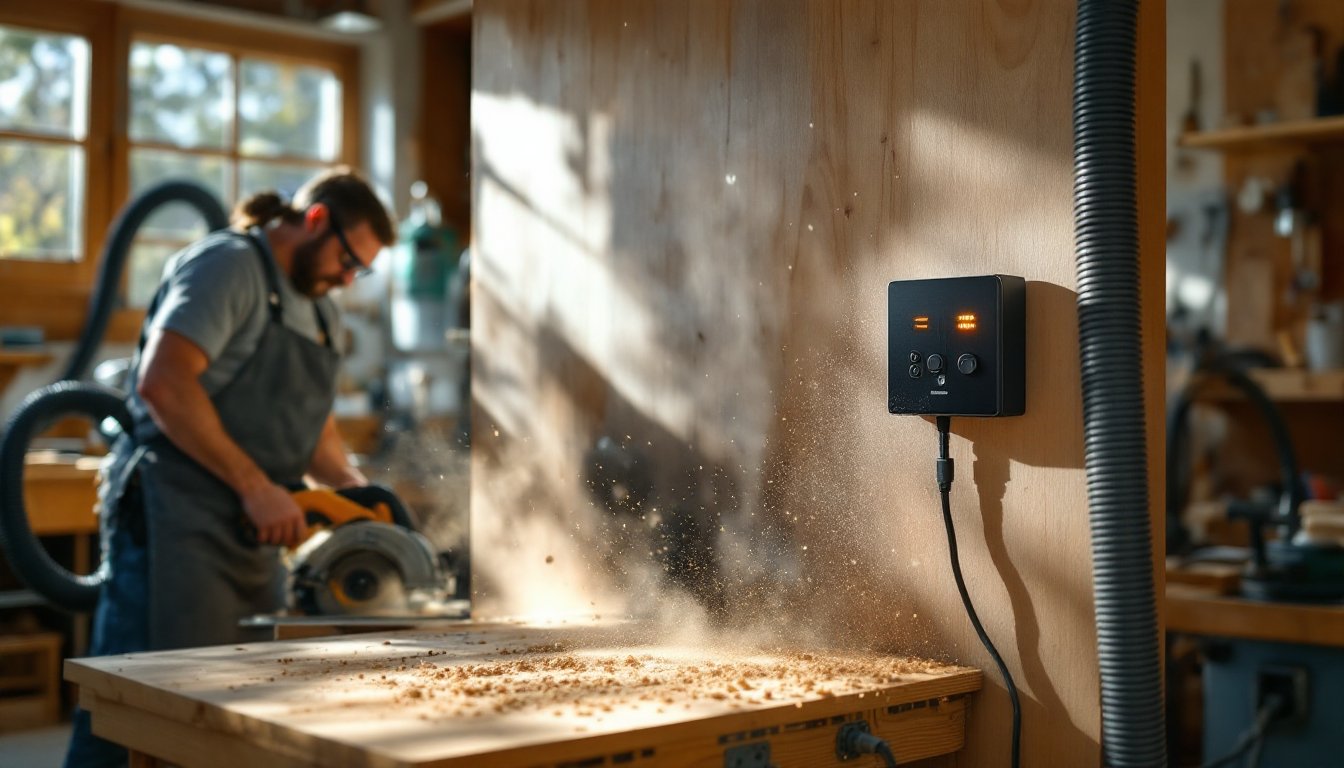
Dust in the workshop isn’t just annoying, it’s a health hazard and a productivity killer. When a circular saw fires up or a random orbital sander kicks into high gear, sawdust clouds engulf the workspace in seconds. Most DIYers manually flip on their dust collection system before starting work, then forget to turn it off when the job ends. An automatic vacuum switch solves this problem by detecting when power tools start and triggering the dust collector automatically. No more flipping switches, no more dust settling on every surface, and no more breathing fine particles that linger in the air. This simple automation upgrade transforms workshop safety and cleanliness with minimal fuss.
Table of Contents
ToggleKey Takeaways
- An automatic vacuum switch detects when power tools activate and triggers dust collection automatically, eliminating manual switching and improving workshop safety and air quality.
- Automatic vacuum switches use current-sensing relays that respond in milliseconds, starting dust collection before sawdust clouds form, and feature configurable delay timers to ensure complete dust clearance.
- Fine woodworking and metal particles pose serious respiratory hazards like occupational asthma and bronchitis; an automatic vacuum switch significantly reduces airborne dust concentration and ambient exposure risk.
- Plug-in switches (up to 15 amps) suit portable shop vacs and small collectors, while hardwired versions handle larger 240V dust collectors and can monitor multiple tool circuits simultaneously.
- Proper sensitivity calibration between 1.5–2.5 amps prevents false triggers from phantom loads, and hardwired installation should follow local electrical codes and may require a licensed electrician for safety.
What Is An Automatic Vacuum Switch?
An automatic vacuum switch is a relay-based electrical device that detects when a power tool turns on and automatically energizes a dust collector or shop vac connected to it. Rather than requiring manual activation, the switch senses the power draw from your circular saw, table saw, miter saw, or sander, then immediately powers up the vacuum. When the tool shuts off, the switch cuts power to the collector after a brief delay, usually 10–30 seconds, to capture lingering dust.
These devices come in two primary types: hardwired switches that integrate into your workshop wiring system, and plug-in adapters that sit between your tool’s plug and the wall outlet. Hardwired versions offer permanent installation and handle multiple tools simultaneously: plug-in models are portable and ideal for renters or shops with limited electrical infrastructure. Both rely on a current-sensing relay that monitors electrical current flowing through the circuit. When current exceeds a preset threshold, the relay activates the vacuum outlet.
How Automatic Vacuum Switches Work
The mechanism behind an automatic vacuum switch is straightforward. Inside the unit sits a current-sensing relay (sometimes called a current monitor or load switch) that continuously measures electrical current. When you press the start button on a power tool, current flows through the circuit. Once that current reaches the switch’s sensitivity threshold, typically set between 1 and 3 amps, the relay triggers.
This relay closure activates a contactor or solid-state relay that energizes an outlet or hardwired circuit powering your dust collector. Some switches include a time-delay circuit that keeps the vacuum running for 15–45 seconds after the tool stops. This delay prevents constant cycling and ensures all dust clears from the tool and collection pathways before the system shuts down.
Plug-in models draw power directly from a standard wall outlet and don’t require any rewiring. Hardwired versions connect to a dedicated 120V or 240V circuit in your breaker panel and can drive larger 240V dust collectors. Both respond in milliseconds, fast enough that dust collection starts before sawdust clouds form. The simplest versions are entirely passive, requiring no WiFi, batteries, or programming.
Key Benefits For Workshop Owners
An automatic vacuum switch eliminates manual switching, which translates to real convenience and fewer forgotten steps. Dust collection becomes seamless: the moment a tool powers on, the vacuum is already running. This removes the cognitive load of remembering another switch and reduces the temptation to skip dust collection on quick jobs. Over time, that consistency means cleaner air, easier cleanup, and longer tool life.
Workshops with multiple stations benefit enormously. If a hardwired switch monitors several tool circuits, a single dust collector can service multiple workstations without additional operator input. A woodworker moving between the table saw and jointer doesn’t need to manually engage and disengage the vacuum at each station.
Health and Safety Advantages
Fine woodworking dust and metal particles are known respiratory hazards. Inhaling these particles over years can cause occupational asthma, bronchitis, and other lung conditions. OSHA recognizes wood dust exposure limits, and many jurisdictions enforce stricter standards for workshops producing commercial goods.
Automatic vacuum activation significantly reduces airborne dust concentration. Because the collector runs immediately, before the operator even looks up from the cut, peak dust levels stay lower. This isn’t a substitute for a respirator when needed, but it substantially reduces ambient dust and the overall exposure risk. Many experienced woodworkers report noticing an immediate difference in air clarity and less post-workshop coughing after installing an automatic switch. It’s particularly valuable in small enclosed shops where dust accumulation happens fast.
Choosing The Right Automatic Vacuum Switch
Selecting the right switch depends on your workshop layout, tools, and budget. Start by identifying your dust collection system. Is it a portable shop vac (typically 5–20 amp draw) or a larger stationary dust collector (often 240V, 20+ amps)? Plug-in switches max out around 15 amps, so they work well for shop vacs and small collectors but may not suit high-powered industrial equipment.
Next, assess your tool lineup. Single-tool switches are simpler and cheaper, designed for one tool per outlet. Multi-tool switches or systems can monitor several circuits and coordinate a single dust collector. If your workshop has a table saw, miter saw, and jointer, a multi-tool system with proper load distribution is more efficient than three separate switches.
Sensitivity settings matter. Most professional-grade switches allow adjustment of the current threshold so they don’t trigger from phantom loads or standby draws. A 1.5–2.5 amp threshold typically catches hand tools and small machines without false positives. Budget models may have fixed settings, which can lead to premature switching or missed activation.
Check the delay timer. A 20–30 second tail-off is standard and keeps dust clearing after the tool stops. Longer delays waste energy but ensure complete clearing: shorter delays reduce electricity costs but risk missing fine particles. Finally, verify the switch can handle your tool’s actual amperage at startup. Induction motors draw 2–3× their running current during startup, so choose a switch with adequate capacity.
Installation and Setup Tips
Plug-in switches are the easiest route for most DIYers. Simply plug the switch into a wall outlet, plug your tool into the switch, and set the sensitivity dial. Plug your dust collector’s hose into a second outlet that the switch controls (or hardwire it to the controlled outlet). Test by powering on your tool: the vacuum should start within 1–2 seconds. Adjust the sensitivity dial if the switch triggers on standby or misses tool activation.
For hardwired installation, you’ll need to understand your home or shop’s electrical panel. Shut off power to the relevant breaker and verify the circuit is dead using a non-contact voltage tester. Run new 12-gauge wire (for 120V) or 10-gauge wire (for 240V) from the breaker to the switch location, then run another run to the dust collector outlet or circuit. This work often requires a licensed electrician and building permits, especially if you’re adding new circuits or working with 240V equipment. Never skip this step: improper electrical installation is a fire and shock hazard.
Once installed, calibrate the sensitivity. Power up a tool and listen for the vacuum to activate. If it doesn’t trigger, slightly reduce the sensitivity threshold. If it triggers randomly from background current, increase the threshold. Document your final settings. Periodically test the switch during annual tool maintenance, debris can sometimes obstruct the current-sensing mechanism. Keep the switch in a dry location: moisture corrodes the relay contacts over time.
Conclusion
An automatic vacuum switch transforms workshop dust collection from a manual chore into a transparent, always-on system. Whether choosing a simple plug-in adapter or a hardwired multi-tool system, the core benefit remains: cleaner air, healthier lungs, and genuinely convenient operation. For any serious DIYer or small workshop owner, the modest investment pays dividends in health, cleanliness, and the sheer relief of not forgetting another switch.